- Home
- Blog
- Outcome-Based Cleaning: Why Facility Managers Are Moving Beyond Traditional Cleaning Schedules
Outcome-Based Cleaning: Why Facility Managers Are Moving Beyond Traditional Cleaning Schedules
Facility managers are shifting to outcome-based cleaning to enhance efficiency, reduce costs, and improve satisfaction by focusing on results, not routines.
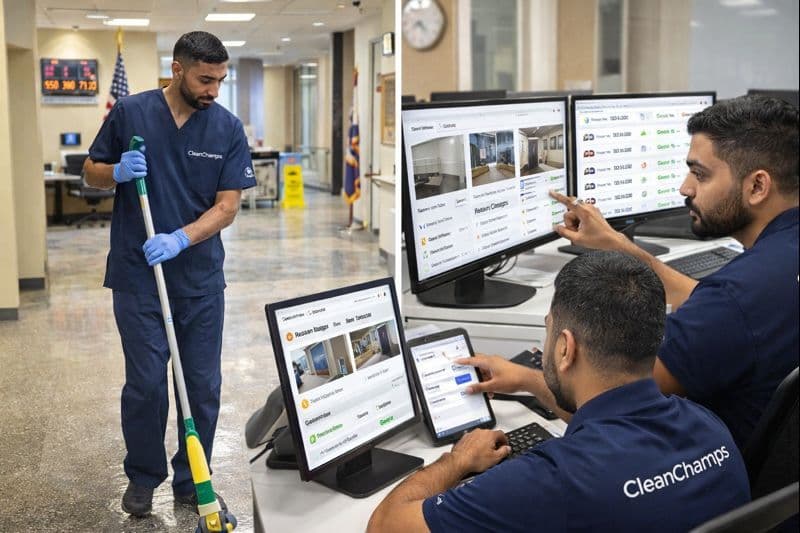
For decades, commercial cleaning services have followed the same formula:
Fixed schedules.
Fixed frequencies.
Fixed costs.
Clean the lobby twice a day.
Restrooms every two hours.
Offices every night.
It’s familiar. It’s easy to manage.
And in modern facilities, it’s no longer effective.
Across healthcare, commercial real estate, education, and mixed-use facilities, Facility Managers are replacing traditional cleaning schedules with outcome-based cleaning models.
This shift isn’t a trend—it’s a structural change in how facility operations measure cleanliness, control costs, and manage risk.
The Problem With Frequency-Based Cleaning Models
Traditional janitorial services are built on one flawed assumption:
More cleaning equals better results.
In real-world facilities, that assumption often leads to inefficiency and blind spots.
Common challenges Facility Managers face with frequency-based cleaning include:
Over-cleaning low-traffic areas
Under-cleaning high-risk or high-traffic zones
Rising labor costs without quality improvement
Ongoing complaints despite full cleaning schedules
No objective way to measure cleaning performance
A restroom cleaned every two hours can still fail inspection if peak traffic happens between cleanings.
A conference room cleaned nightly may sit unused for days.
The result is wasted labor, inconsistent results, and frustrated stakeholders.
What Is Outcome-Based Cleaning?
Outcome-based cleaning shifts the focus from time-based tasks to performance-based results.
Instead of asking:
“How often should this space be cleaned?”
Facility Managers ask:
“What condition does this space need to be in at all times?”
Under an outcome-based cleaning model, janitorial providers are accountable for:
Defined cleanliness standards
Measurable hygiene outcomes
Response times
Occupant satisfaction
Cleaning services are evaluated based on results—not hours logged or tasks checked off.
This aligns closely with performance-based cleaning contracts, where success is measured by benchmarks instead of routines.
Cleaning KPIs: The Backbone of Outcome-Based Models
Outcome-based cleaning only works when performance is measurable.
That’s where cleaning KPIs come in.
Common janitorial performance indicators include:
Cleanliness audit and inspection scores
Complaint frequency and resolution time
High-touch surface compliance
Restroom condition ratings
Health and safety incident reduction
Occupant and tenant satisfaction feedback
These metrics give Facility Managers something traditional cleaning models rarely provide:
Visibility.
Instead of reacting to complaints, teams can identify patterns, redeploy labor strategically, and prevent issues before they escalate.
Why Facility Managers Are Driving the Shift to Outcome-Based Cleaning
Facility Managers today face more pressure than ever:
Tighter operating budgets
Higher health and safety standards
Increased scrutiny from tenants, employees, and regulators
Greater accountability through reporting and audits
Outcome-based cleaning directly supports these demands by tying janitorial services to operational performance.
1. Better Cost Control Without Lowering Standards
Labor is deployed based on usage, traffic, and risk—not habit.
Cost savings come from efficiency, not reduced service levels.
2. Reduced Risk and Liability
Measurable hygiene outcomes strengthen quality assurance, especially in healthcare, food service, and high-traffic facilities.
3. Fewer Complaints and Faster Resolution
Issues appear as data points instead of surprises, allowing teams to act early.
4. Stronger Vendor Accountability
Performance expectations are clear, documented, and defensible—eliminating ambiguity in vendor management.
Quality Assurance in Modern Facility Cleaning
Outcome-based cleaning doesn’t eliminate oversight—it improves it.
Instead of subjective walkthroughs or annual reviews, Facility Managers rely on:
Scheduled inspections
Spot checks in high-risk areas
Performance trend analysis
Documented corrective action plans
This creates a continuous feedback loop where quality assurance becomes proactive instead of reactive.
Why Outcome-Based Cleaning Reports Matter
Traditional cleaning reports focus on:
Tasks completed
Hours worked
Supplies used
Outcome-based cleaning reports provide:
KPI performance trends
Risk reduction metrics
Cost-to-performance ratios
Measurable improvement over time
For leadership teams, this transforms cleaning from a necessary expense into a measurable component of operational excellence.
Why Frequency-Based Cleaning Is Becoming Obsolete
Frequency-based cleaning struggles in environments where:
Foot traffic is unpredictable
Health standards are non-negotiable
Budgets require justification
Performance must be defensible
Outcome-based cleaning succeeds because it reflects how modern facilities actually operate—dynamic, data-driven, and accountable.
Final Thought: Cleaning Outcomes Over Cleaning Schedules
The question Facility Managers are asking today isn’t:
“How often are we cleaning?”
It’s:
“Are we achieving the cleanliness and hygiene outcomes this facility requires?”
Facility Managers who adopt outcome-based cleaning models aren’t just improving cleanliness—they’re improving operational control, reducing risk, and aligning janitorial services with modern facility management strategies.
Once outcomes become the standard, schedules alone are no longer enough.